HRIS • HCM • DATA MIGRATION • TESTING • PROJECT MANAGEMENT
HRIS Performance Data Migration
HRIS implementation project focused on employee performance data migration, field mapping, data transformation, validation, reconciliation, UAT, testing, and migration-readiness planning.
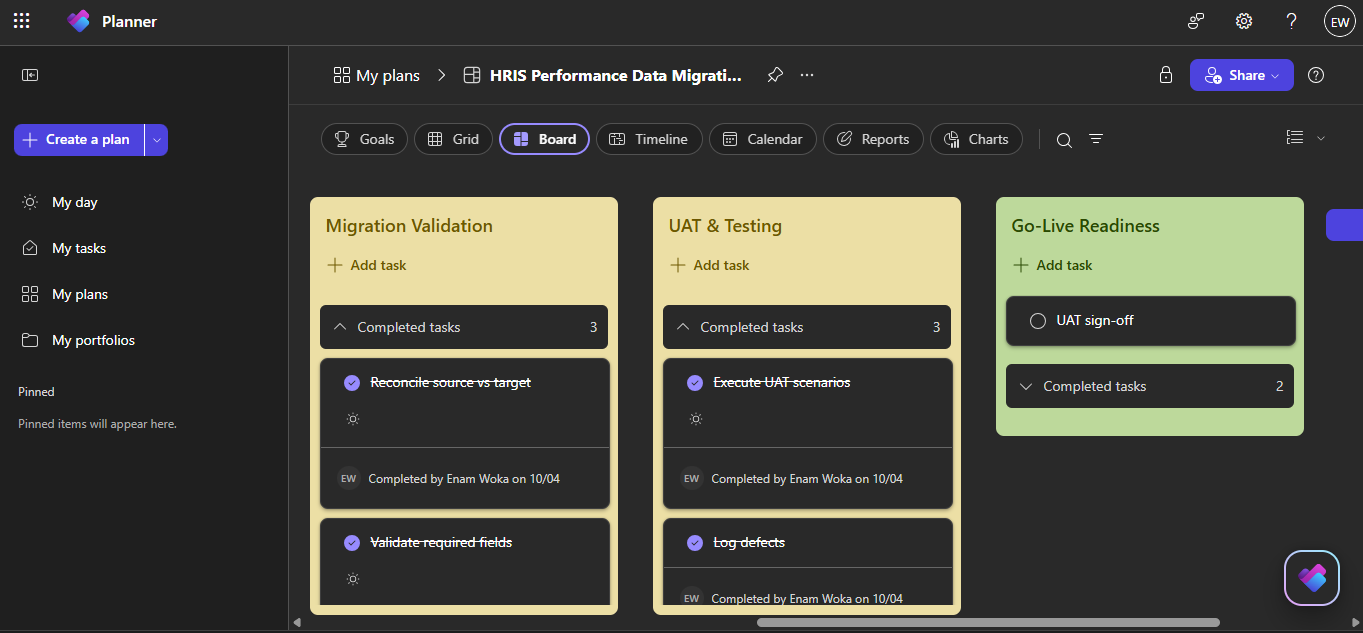
HRIS data migration implementation plan — structured activities covering data assessment, transformation, validation, testing, and migration readiness.
PROJECT OVERVIEW
Preparing HR performance data for HRIS migration
This project simulated an HRIS performance-data migration from a legacy HR system into a target HRIS environment.
The project covered the data-migration lifecycle from initial data assessment and field mapping through transformation, validation, UAT, and implementation readiness.
BUSINESS PROBLEM
Migrating HR data without compromising data quality
Legacy HRIS data can contain inconsistent field values, missing information, duplicate employee records, invalid dates, and differences between source and target-system structures.
The objective was to establish a controlled migration process that would identify data issues before migration, standardize the data, validate the transformed records, and prepare the dataset for user acceptance testing.
MIGRATION PROCESS
Legacy data → Migration-ready data
01 — Data Assessment
Reviewed the legacy HRIS extract and identified data-quality
issues requiring remediation before migration.
02 — Field Mapping
Created a source-to-target field mapping matrix documenting
legacy fields, target HRIS fields, transformation rules,
and validation requirements.
03 — Data Transformation
Used Power Query to standardize department values,
performance ratings, dates, and other HR data fields.
04 — Validation & Reconciliation
Validated required fields, employee identifiers,
manager relationships, dates, and approved HR values.
05 — UAT & Testing
Developed test scenarios to verify data quality,
transformation rules, and migration readiness.
06 — Migration Readiness
Documented outstanding exceptions and established
readiness criteria before production migration.
PROJECT VISUALS
HRIS Data Migration & Validation Visuals
Selected evidence from the legacy-data assessment, field mapping, Power Query transformations, validation activities, exception handling, and migration readiness process.
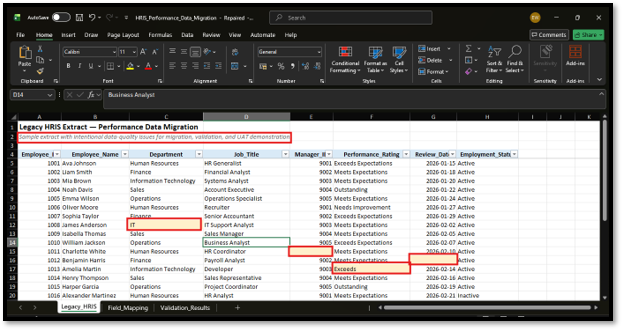
Legacy Data Assessment
Reviewed the legacy HRIS extract to identify data-quality issues requiring remediation before migration.
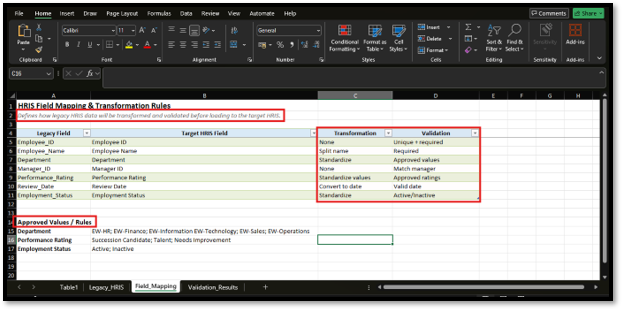
Field Mapping Rules
Defined source-to-target field mappings and transformation rules to support consistent migration into the target HRIS.
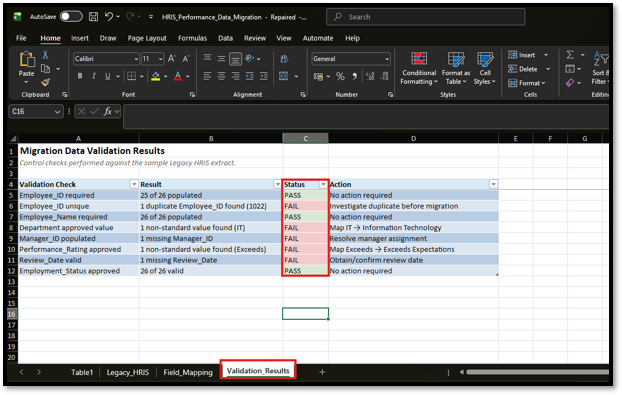
Initial Data Validation
Performed initial validation of migration records against required fields and expected HRIS values.
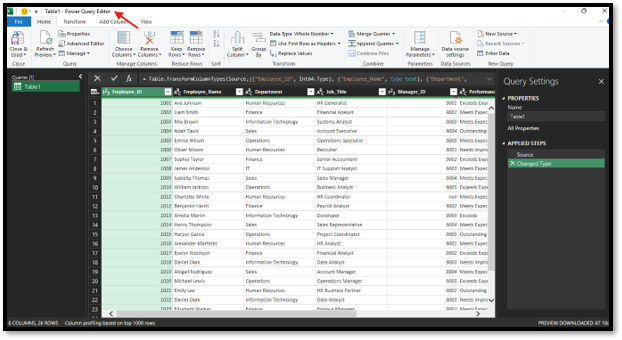
Data Cleansing
Used Power Query to cleanse and standardize legacy HRIS records before migration.
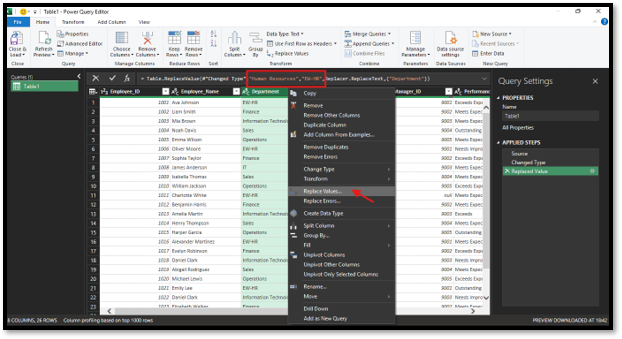
Value Standardization
Replaced inconsistent legacy values with standardized target-system values.
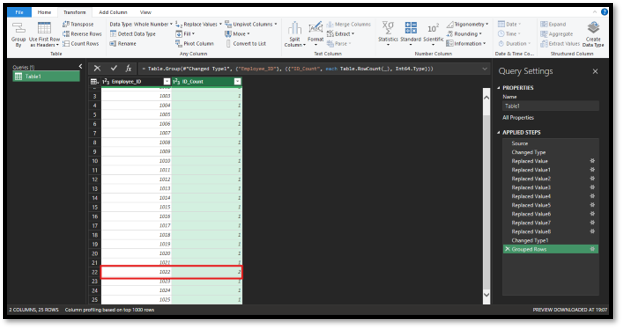
Duplicate Record Review
Identified duplicate employee records to prevent duplicate data from entering the target HRIS.
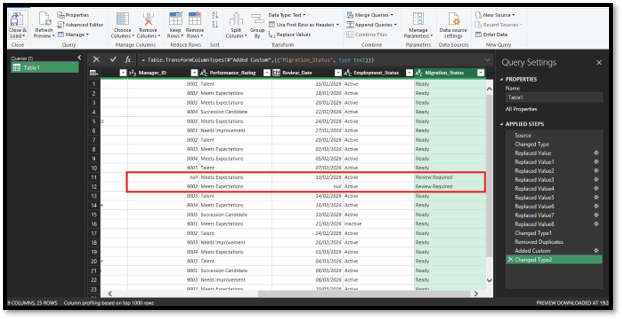
Migration Exceptions
Flagged records requiring additional review rather than allowing unresolved data issues to proceed automatically.
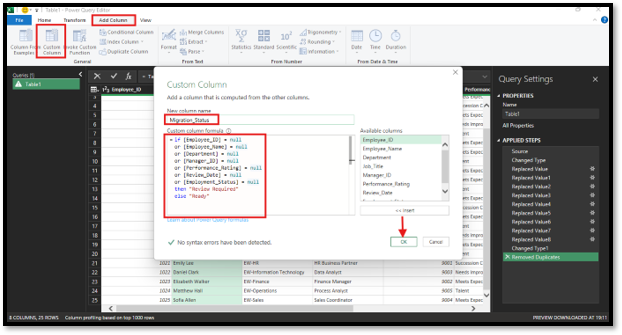
Migration Status Logic
Applied validation logic to classify records as ready for migration or requiring further review.
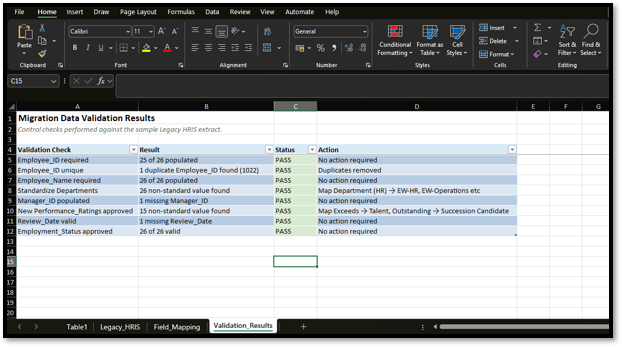
Validation Complete
Completed final validation to confirm that the transformed dataset met the defined migration requirements.
FIELD MAPPING
Source-to-target HRIS mapping
A field-mapping matrix was used to define how legacy HRIS fields would translate into the target HRIS structure.
Mapping considerations included field names, required fields, data types, transformation rules, validation requirements, and approved values.
Example:
Performance_Rating → Performance Rating → Standardize rating values → Validate against approved ratings
Review_Date → Review Date → Convert to valid date → Validate date format
Department → Department → Standardize department values → Validate against approved departments
DATA TRANSFORMATION
Standardizing legacy HR data
Power Query was used to transform the legacy dataset before migration.
Key transformations included:
• Standardizing department names
• Standardizing performance ratings
• Converting review dates to valid date fields
• Identifying duplicate employee IDs
• Identifying missing required fields
• Creating migration-readiness status
VALIDATION & RECONCILIATION
Confirming migration readiness
Validation checks were designed to confirm that transformed records met defined HRIS migration requirements.
Key validation areas included:
• Employee ID uniqueness
• Required-field completion
• Department mapping
• Performance-rating values
• Manager relationships
• Review-date validity
Records requiring remediation were separated from migration-ready records so that exceptions could be resolved before production migration.
UAT & TESTING
Testing the migration process
UAT scenarios were created to validate the transformed HR data and confirm that key business requirements were satisfied.
Example test scenarios included:
Employee ID uniqueness — Confirm no duplicate employee identifiers exist.
Department mapping — Confirm legacy department values are converted to approved target values.
Performance rating — Confirm ratings conform to the target HRIS structure.
Manager relationship — Confirm employee manager relationships can be validated.
Review date — Confirm review dates are valid and correctly formatted.
PROJECT DELIVERY
Managing the HRIS implementation lifecycle
Microsoft Project was used to structure the migration activities into phases, tasks, dependencies, testing activities, and implementation milestones.
The project plan covered:
• Discovery and data assessment
• Field mapping
• Data transformation
• Migration validation
• UAT testing
• Defect resolution
• Final validation
• UAT sign-off
• Migration readiness review
DOWNSTREAM IMPACT
Considering the impact beyond the migration
Data-quality issues were considered not only from a migration perspective but also in relation to downstream HR processes and reporting.
Incorrect employee, manager, department, performance, or review-date information could affect reporting, performance management processes, employee records, and future HR analytics.
OUTCOME
A controlled HRIS migration framework
The project established a structured approach for preparing legacy HR performance data for migration, including field mapping, transformation, validation, reconciliation, UAT, and project planning.
The approach provides a repeatable framework for identifying migration risks before data reaches a production HRIS environment.
TOOLS
Technology stack
SKILLS DEMONSTRATED